
A quick way to estimate your eligibility is to look at your most recent Form 1040 federal tax return.
Where Do I Look?
On page 2, look in the “Tax and Credits” section.
Find the line that subtracts your tax credits from your income tax. It usually says something similar to:
“Subtract [credits] from [tax]. If zero or less, enter -0-.”
The exact line number can change from year to year, so look for the wording instead of the line number.
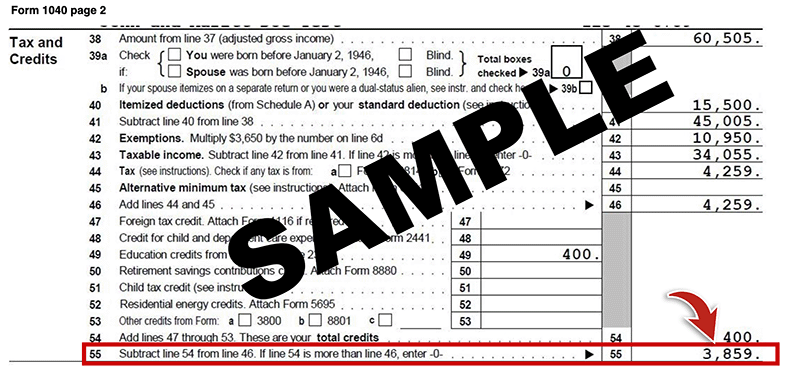
Example only: Tax forms and line numbers change. The highlighted line shows the type of number you are looking for.
In this example, the amount left after other credits is $3,859.
That would generally be enough to use:
Up to a $1,700 EFTC credit for an individual
or
Up to a $3,400 EFTC credit for a married couple filing jointly.
What If My Number Is Smaller?
If you donate $1,700 but only have $1,000 of federal income tax left after other credits, you may be able to use $1,000 of the credit now.
The remaining $700 can generally be carried forward for up to five years.
One Important Thing
Do not look at whether you got a refund or owed money when you filed your taxes.
Getting a refund does not mean you paid no federal income tax.
The number you want is the amount of regular federal income tax left after your other tax credits have been applied.
This is only a simple estimate. Your actual EFTC credit will be calculated when your tax return is prepared.
This page is intended to provide general information about the Education Freedom Tax Credit. Individual tax situations are different. Please consult your tax preparer or tax adviser if you have questions about your personal tax situation.